Stuttgart
Intelligence Through Interaction: Collective Behaviour in Microrobotic Systems

Research Talk
Date: Wednesday, August 26
Time: 11:00 – 12:00 CEST
Location: MPI-IS Stuttgart
About the session: Collective behaviour is ubiquitous in living systems, emerging from local interactions between individuals through physical, chemical, or sensory coupling. This raises a fundamental question for robotics: can collective intelligence be engineered to emerge from the interactions of many simple agents rather than from centralised control? At microscopic scales, where the traditional distinction between sensing, computation, and actuation breaks down, this question becomes particularly relevant. Instead of programming individual robots, we can ask how coordination and functionality emerge directly from the physical design of a system and the interactions between its components.
In this talk, I explore this idea through three experimental microrobotic platforms: magnetic microdisks with tuneable interactions, self-propelling oil droplets that serve as physical models of cell-like behaviour, and electrically driven lipid vesicles, cell-sized soft compartments that exhibit emergent motion despite their minimal structure. Across these systems, there is no central controller, onboard computation, or explicit separation between sensing and actuation, yet coherent collective behaviours and functional organisation emerge. Together, they illustrate a paradigm for microrobotics in which intelligence is embodied in materials and interaction rules, making intelligent behaviour an intrinsic property of the system rather than a programmed feature of individual agents.
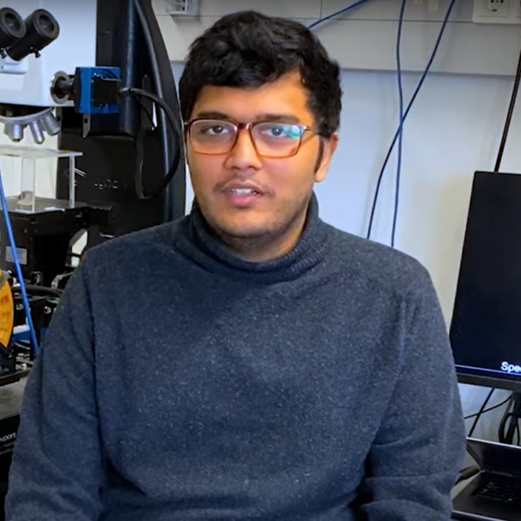
About Gaurav: I am a postdoctoral researcher in the PI department at MPI IS in Stuttgart, working on emergent collective behaviour in microscopic physical systems and its applications to microrobot collectives. Outside work, I enjoy reading books, playing racquet sports, and having philosophical discussions.